Henry Rollins is an especially compelling case study for me. Growing up in the D.C. area, although once filling in as an emergency vocalist for Teen Idles (his longtime buddy Ian MacKaye’s first band), Rollins initially made his mark fronting State Of Alert. If hardcore is typically defined as second generation punk, a little more muscular and fluid than its predecessor, then S.O.A. is directly situated between the two, a transitional link in this music’s lineage.
I would take Rollins any day over the harsh, tuneless screaming puncturing many of his contemporaries’ efforts from this period — and for many to follow. This is without even getting into the lyrics, or the dark, dirty, taboo secret in some circles (gasp!) of what I perceive as a sharp business acumen. He’s definitely intense, possibly not that easy to deal with, but at the same time, you get the impression that shit is going to be handled when it comes to this guy. Which is after all 90% of the issue afflicting bands at virtually every level, disorganization and scattered focus a major reason why most never punch through to a higher plane.
Well, in fact, after playing just a handful of shows, State Of Alert bite the dust all too soon themselves. However this proves no problem for their unstoppable front man, who catches a huge break when he leaps in a few short years from merely a major Black Flag fan…to stepping behind the microphone for them. As they are an established Los Angeles entity with a solid legacy already, Henry must relocate to the opposite coast, but in every other respect they are a perfect fit. The brainchild of guitarist Greg Ginn — self-releasing their albums on his own indie label, SST, with extremely cool and consistent looking artwork designed by his brother Raymond — they had gotten off to a hot start with original vocalist Keith Morris, but experienced just as many rough patches since, with a couple replacements (you may recall that their second singer, Ron Reyes, briefly jammed with some of the GN’R guys before they landed Axl Rose; let’s just say those cats made the right choice) that proved a mixed bag. Dez Cadena has his supporters, and is a crowd favorite, yet when shredded pipes force him to switch over to guitar instead, the band lucks into a huge, career defining goldmine by eventually settling upon Henry Rollins as his successor.
One would be remiss to suggest that Black Flag were getting nowhere without Rollins, particularly Ginn himself when you consider SST and their eventual slew of classics. At least to some degree, however, here once again it seemingly takes an outsider moving to L.A. to light a fire under the troops and start making things happen. However, I think this points more to Greg Ginn — who, after all, can be glimpsed wearing polo shirts while performing at these punk rock shows, even in 1979, who liked to smoke pot and listened to the likes of Hendrix or the Dead, who had the audacity to grow his hair long alongside his Black Flag comrades at the height of this hardcore scene — as a notable fluke outlier than it does refute this theory.
Still, it’s a bit surprising to discover that Ginn actually wrote most of the lyrics, for they often hew mighty close to Rollins’s own sensibility. Although this is maybe not so stunning when you consider Henry all but subsisted on Black Flag during his formative years. And though unsure about either his worthiness or whether this would make a good fit, Henry was able to acclimate himself slowly and determine the move made sense: it’s only during an east coast swing for Black Flag that Rollins first meets the guys, then, upon being offered the gig, tours with them as merely a roadie and observer while learning the ropes. Damaged, their first full length album after a handful of singles/EPs, marks Rollins’s recorded debut with the group.
Ginn has gone on record stating that they lost their sense of humor when Henry joined, because he’s so unrelentingly intense. Though I would have to disagree with this assessment — intense guys can be funny, too! — it’s certainly understandable where this is coming from. Rollins’s preferred stage gear is nothing more than a pair of black shorts, as he stands there sideways, crouched like a panther, lightly springing on the balls of his feet as though ready to pounce at any moment. Clutching the microphone and delivering his lines with such ferocity that you don’t doubt a word of what he’s saying. An image that his muscle ripped, tattooed covered figure and vaguely possessed glare do little to ameliorate.
If nothing else, however, Henry at least possesses enough chops to sell the lines that Greg is penning, some of which are even mighty comic. Of course TV Party is the uncontested classic in this realm, from this batch of songs, a spirited creed against mindlessly watching The Jeffersons, Hill Street Blues, Saturday Night Live, and many other such name-checked offenders. The video itself, as you can see, is also an undeniable classic, and if it didn’t directly inspire The Beastie Boys’ eventual clip for Fight For Your Right (To Party), then you have to concede they at least cribbed the vibe. The ripped tee shirt Henry somehow acquires in the process of drinking beer on a couch is but one of its many highlights.
Musically, many fans are initially not fond of this new, twin guitar attack presented by Ginn and Cadena. Or should we say, those who are able to actually get their mitts on a copy might be heard grumbling about this. For one of the ironies of Ginn’s hallowed status as bearing this indie torch for so long, running SST Records, is that his own band had in fact originally contracted with major label MCA to distribute Damaged, via their Unicorn imprint. Except Unicorn was in the throes of an eventual bankruptcy, and claimed they had no money for releasing this album…then pressed charges when SST attempted doing so itself, a stalemate that left Black Flag in a hellish limbo for years. As a result, there’s a first vinyl pressing out there of 25,000 copies which bear the MCA logo, though a crude attempt was made at stickering these over.
At one point, Black Flag was prevented from releasing any more music under this name, until the legal situation sorted itself out. I can’t even imagine what a tortuous situation this must have presented, for a band just now beginning to generate some momentum, one which surely only fueled their inherent rage, the sorry state of this world’s affairs which they were commonly railing against. They were even scheduled to play Saturday Night Live during this era (Belushi was reportedly a fan), but when fellow punks Fear went berserk and got themselves banned, that stunt in essence screwed an entire genre of music, as Lorne Michaels personally nixed the Black Flag gig. None of which was helping their momentum any, either, another potential legend making turn thwarted.
Press enter or click to view image in full size
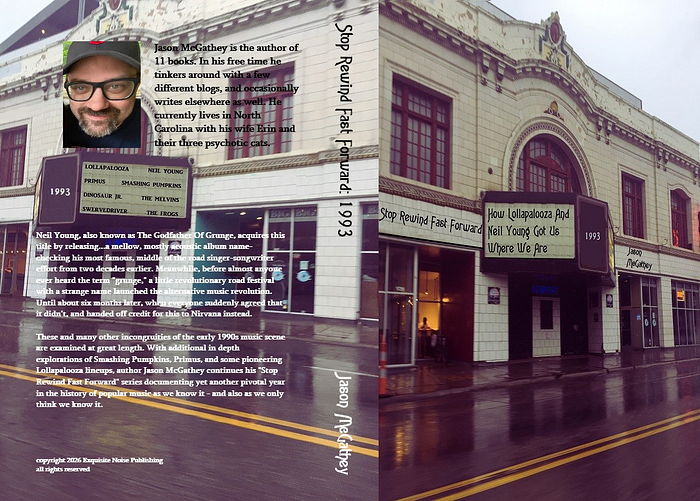
The above excerpt is but a sliver of my extended essay on Henry Rollins, found in my latest music history book, Stop Rewind Fast Forward: 1993. If this grunge-era recap seems like your cup of strong, independently brewed java, you can order it direct from me in a couple different places:
