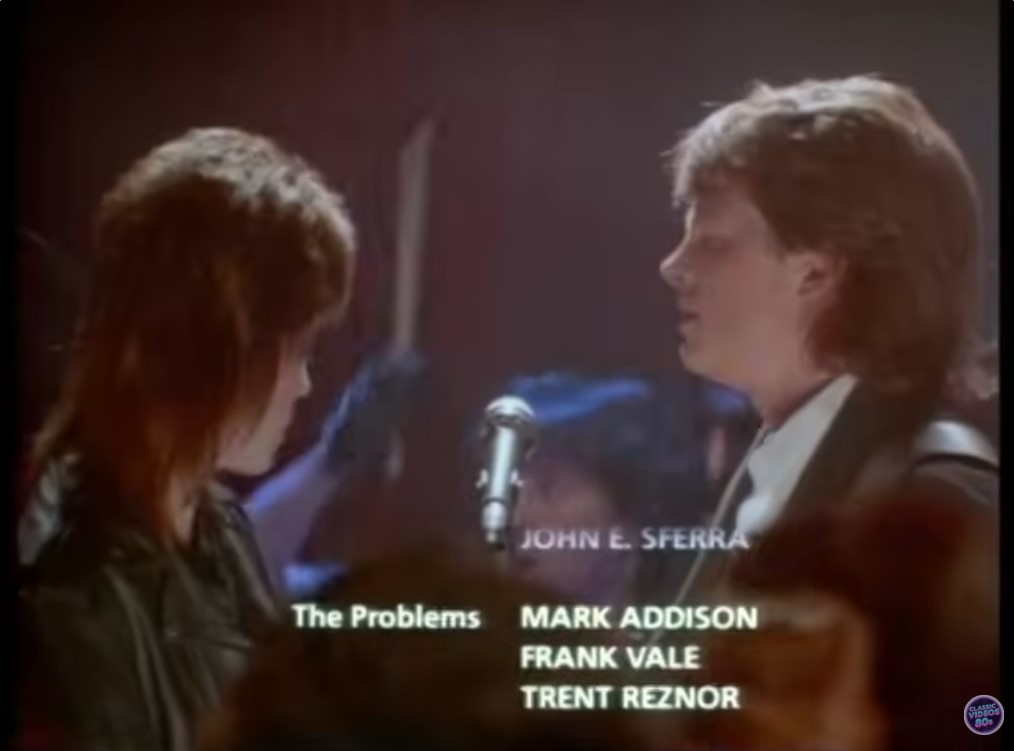
Like Ice-T, Trent Reznor has always displayed a preternatural gift for networking. Before he’s even formed the eventual band that made him famous, for example, his previous outfit, often referred to as Exotic Birds, somehow landed a performance in the movie Light Of Day, in 1987. Even for a crumbling shell of a city like Cleveland, this is impressive (if curious, I wrote a previous post about this movie). Basically I think this was Reznor and one other guy from Exotic Birds, joined by some random dude they used to jam with, calling themselves The Problems in this film.
Trent’s already in his early 20s and relatively well advanced in his musical career at this point, if still lacking a record deal, and not yet having made a name for himself in any other way. As someone who grew up in small town Pennsylvania, Reznor actually enjoys a much more idyllic childhood than one might expect, given his perpetual public frown.
And yet, every report I’ve seen indicates a stable family dynamic, his early interest in piano playing, subsequent joining of jazz and marching bands in high school, and apparently suffering nothing more traumatic in his home life than being forced to watch an excess of television, only because there’s nothing else happening in his neighborhood.
All signs point to a normal, middle-class upbringing. Except the elements which maybe indicate something even better: I remember a friend of mine scoffing one day in the mid 90s upon learning that the Reznor air conditioners and heaters spotted everywhere were attributable to Trent’s great grandfather, who’d founded the company, and that the family was allegedly doing quite well as a result.
I will admit that backstory does threaten this image of some edgy, angst riddled youth emerging from the grimy, post-industrial streets of Cleveland to conquer all. Or at least it would if you cared about such. My own take on this stuff is that people are angry everywhere, from every walk of life, and complaining while middle class doesn’t automatically make one a poseur. We might wish to smirkingly suggest that perhaps Trent would like to be dropped into the middle of the Sahara in his shiny black leather outfit, if he really wants something to complain about, but I’ll save that topic for another day.
Regarding the eventual, mostly one-man-band for which he became a household name, Nine Inch Nails first hit store shelves in 1989, with their debut album, Pretty Hate Machine. Though overall not a huge fan of this release, it still seems shocking to me to think this technically squeaked in as a 1980s project, because to this day it sounds far ahead of its time. Head Like A Hole was even a hit on MTV, and over the years Terrible Lie or to a lesser extent Down In It have become popular songs as well. Yet although an impressive effort for a young kid doing most of the work himself, with a fully formed vision that’s already off the charts, for me it’s never been all that enjoyable an album to actually listen to. There are some definite clunkers, his lyrics and/or vocals cringe inducing in spots. And even that trio of hits don’t exactly find their way into my playlists.
But make no mistake about it, he’s a brilliant songwriter, and would only get better as the years progress. With Trent naturally at the helm, Nine Inch Nails are one of the main stage acts on the first ever Lollapalooza tour, in 1991. On those shows, they’re already playing at least two new songs every night. Among these is Wish, which will become my all-time favorite track of theirs thus far.
It will eventually appear on the Broken EP, issued in 1992. A full-on aural assault featuring the greatest ever use of a country music “train” drum beat, a train beat thundering straight up the line from hell, Trent has also arranged the empty spaces with precision, so that as the equally brutal guitar riffage kicks back in, the effect is nothing short of pulverizing. Even though you’re expecting it, each time, down to the millisecond.
This live clip improves upon the original, with an even more aggressive attack. I’m not sure exactly when and where this version was played, but you get the basic point, and if you’re digging this then by all means seek out the original. Ye shan’t be disappointed.

The above excerpt is but a sliver of my extended essay on Nine Inch Nails, found in my latest music history book, Stop Rewind Fast Forward: 1993. If this grunge-era recap seems like your cup of strong, independently brewed java, you can order it direct from me in a couple different places:
Recommendation of the Week:
I didn’t manage to find any book to throw at you this time around. However, it occurred to me to mention Beehiiv, a platform for helping to scale and monetize your newsletter, one which I’ve been using for years. I should mention this is an affiliate link and therefore I will make a small commission if you sign up. Also that Medium seems to mysteriously suppress my posts if including links elsewhere (yet wondering why their reach continually and progressively vanishes over time — perhaps misguided attempts at “gaming” their own system instead of letting organic growth just happen might play a part? Hmm? Radical theory, I know). But, eh, I’m including this link anyway. If you are a newsletter creator, you might wish to give it a try: