Former Siouxsie Sioux associate and would be Banshee Billy Idol’s Cyberpunk is released in June of ’93 to what are easily the most horrific reviews of his career. The album’s lasting legacy, however, will surely have nothing to do with the music whatsoever. As a hair-era rocker who’s (an unthinkable) three years beyond his last big hit, Cradle Of Love, his chances of landing another in this climate were already mighty slim anyway. And Cyberpunk only reaches #48 on the U.S. charts, which does indeed indicate that the masses have by and large moved on. Still, I would argue that this release demonstrates once again that it’s better to dispense an album that’s universally, notoriously considered godawful — as opposed to one that is merely so-so or bad, and goes nowhere.
I mean, I caught the video for Shock to the System a couple times, and pretty much thought, eh, it isn’t great, but whatever. And you get the sense that this would have represented everyone’s reaction, more or less, as the album then died a quick death and slipped from view. If not for a pair of disparate responses, which are not even remotely connected — at least not without considerable contortions — one of them swift, vocal, immediate, the other slower moving, quieter, but likely of greater long-term significance.
The seeds for this album are germinated during a stretch where Idol finds himself laid up following a motorcycle accident. Already stuck hanging out around the house all day, owing to a broken leg, he develops an interest in goofing off on computers, as well as reading book after book on the culture surrounding them. The exact sequence of what begat what is not entirely clear, but these events are all loosely connected and will occur within the same short time frame. For example fabled underground writer Legs McNeil drops by to interview Billy and, observing the electronic gadget on his leg for keeping his muscles from atrophying, jokingly refers to Idol as a “cyberpunk.”
Eyes wide at the seeming coincidence between this tossed off comment and his burgeoning interests in computers, Idol understandably ran (or hobbled) headlong toward this theme. The term cyberpunk, as McNeil surely knew, was most commonly applied to a subgenre of science fiction, mostly burbling in the underground since at least the 1970s. As of 1993 the average joe has still never heard this term, however, although anyone who has ever seen the movie Blade Runner might have some idea what it means: an aesthetic that is both grimy and futuristic at once, heavily dependent upon machines even as humans are mostly living like savages.
One needn’t take a literal meaning of any concept to draw inspiration from it, however. With nothing but time on his hands anyway, Billy begins absorbing every reference point that’s even remotely related to this topic, and in turn fueling his latest batch of songs with such. He also begins recording these tunes at home, on an Apple Macintosh computer, often in conjunction with the Pro Tools digital music workstation program. What we call “coincidence” is often just a case of our attention facing one specific, narrow direction, with occasional objects drifting into this frame, and seemingly finding a perfect home there. As it is for Idol with the L.A. Riots, erupting in response to the Rodney King trial verdict, and the subsequent melee that ensues. What he’s seeing on his TV neatly matches his vision of this “cyberpunk” concept, to the extent they inspire him to redraft his lyrics for Shock to the System. In his free time he’s also absorbing novels like Neal Stephenson’s Snow Crash, and Gareth Branwyn’s forward leaning HyperCard publications, which are basically digital magazines designed for Apple computers.
All of which is very well and good, and makes for a fascinating backstory. I also think it’s great he had the nerve to enact a clean break with his past, in many respects, and forge ahead in this entirely new direction. However, though I halfway expected to play contrarian upon listening to Cyberpunk, and even more so hoped that I could, this is sadly not the case. No bones about it, this thing does kind of suck. But it’s also not as terrible as most would have you believe, and I can’t shake this feeling that if David Bowie had released the exact same album, reviews would have trended much kinder. Yet even if you received a concession from most critics that this is probably true, I am certain their next line of defense would be to argue that Billy isn’t “pulling this off,” that this is their key issue. I don’t think that’s true, however, and am far more convinced that a few strategic missteps are instead what doomed the enterprise, though the seeds of a decent album remain in plain sight.
The primary culprit here is that these programmed beats are mostly atrocious. They don’t sound great in the moment and will undoubtedly age even worse. I get what he’s going for, but if you’re pursuing a cutting edge, futuristic sound, then perhaps you want to spring for the most cutting edge, futuristic beat makers, instead of these random guys nobody has ever heard of — I don’t know that Dr. Dre was available or would ever have agreed to this, but it couldn’t have hurt to reach out and see if he felt like contributing his talents to a track.
If you envision these songs with better (and less repetitive) backing rhythms, then the entire project suddenly doesn’t seem nearly as bad. But then again, I feel like even in his heyday, Idol wasn’t exactly known as a guy who was assembling masterful albums — this was always a brilliant single kind of artist instead. Every release, even his finest, it has featured 2–3 knockout tracks, and the remainder of the material has ranged from okay to horrendous. So while a tremendous stretch maybe to term any song on Cyberpunk “great,” it’s actually possible he has brought forth more first rate ideas here than on any of his previous releases — the problem is, it takes more than this to stitch together a timeless song.
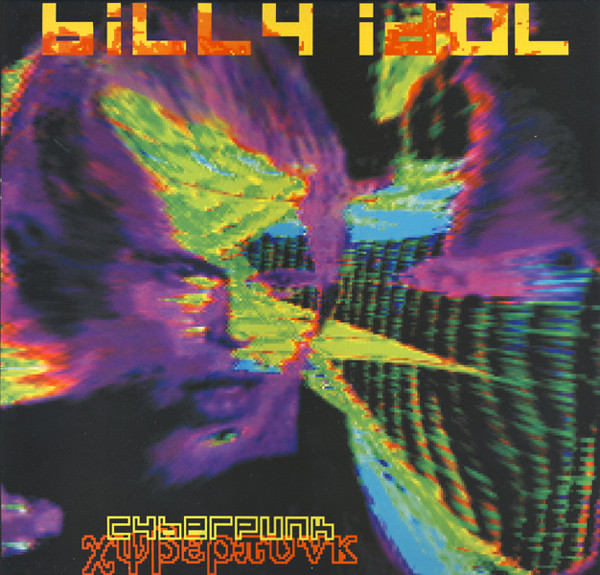
Ultimately, however, it’s the method which he chooses to dispense this material that proves most fascinating. For one, he is probably the first major artist to fire off promotional blasts on this newfangled internet, whether in sending e-mails or posting on forums. And the key inspiration here is author Jaime Levy, a digital pioneer who is already publishing her works to computer disc.
Her creation, Cyber Rag, is commonly hailed as the first magazine distributed on a floppy. Though not actually about music, it does look like some underground rock zine, and is assembled in this spirit, with Levy working alone to concoct these masterpieces. In 1990, while a student at NYU, she’s initially doing such for her master’s thesis, working with the Apple HyperCard medium herself as she pulls together disparate, often pirated images, sounds, self created animation, poetry, scrolling political commentary layered over primitive yet cool looking backdrops, and even homemade computer games. Sold on a single disc, with glued on Xeroxed “covers.”
As he’s already begun work on Cyberpunk, Idol pays Levy five grand to come up with something similar for his album, a promotional disc to accompany his release. His doing so is actually an industry first, a press kit that features song snippets, lyrics, artwork, and other written material centered around this whole cyber-culture concept. Completing the work comes with unexpected complications, however, stemming from a night where the two of them go out drinking. Both are so plastered that Billy somehow manages to accidentally break her dominant arm while they are clowning around. With that hand out of commission, she is forced to clunk around with just the other, though eventually muddling through the project regardless.
The material itself is ultimately not much more than an eye-straining novelty, though this is mostly beside the point. Upon clicking on the “Cyberpunk projector,” icon, on a refreshingly normal old black and white screen, the intrepid viewer/listener is then taken to a garish home page, featuring a backdrop of Billy’s blurry likeness, his name and the album title in “futuristic” fonts, and a few clickable buttons on the left. Also an endless loop of him shouting yeah! over one of these vaguely industrial beats he’s pushing of late. A plus sign shaped icon reminiscent of such on an original Nintendo controller trails alongside the pointer arrow, wherever you might wish to venture next.
Clicking on CONCEPT takes one to a further compartmentalized screen, combining the colors pink and pine green in a manner no human ever should, where the curious can avail themselves of additional info on such topics as Hyper People (the personnel involved), Brain Candy (some touching shout outs to the material that inspired him, such as Levy’s digital magazine, also an interactive cyberculture catalog from Gareth Branwyn, some email newsletters and/or forums you might wish to subscribe to, and helpful instructions to connect your computer to a modem if you want to call up a couple cool websites). The other two buttons reveal the bio behind this Cyberpunk business and an introduction to the album itself, where for example a tinkling keyboard plays behind this ominous phrase:
The future has imploded into the present.
With no nuclear war the new battlefields
are people’s minds and souls.
I don’t know, but this sounds legitimately modern to me, as though he has at least somewhat legitimately tapped into the “cyber” scene if not the entire zeitgeist as whole. Still, it seems unlikely anyone fires up this disc more than twice, so that they might glimpse monstrosities such as the “swarm cam” footage that combines psychedelic imagery, moving video with vapor trails, and ghastly computer effects, to a nightmarish degree not even the Chili Peppers’ Higher Ground video could ever touch. It’s still an ambitious swing for the fences, and a refreshing update from the stale old tried and true promotional gimmicks we’ve all grown accustomed to. His record label, Chrysalis, is even originally planning on issuing the album in CD-ROM form, which would be the complete release alongside all these materials, but when the project tanks and Idol is mostly excoriated for this dud, these notions are quickly scrapped.
Much of the furor has nothing to do with quality concerns, but rather a sizable throng of “authentic” cyberpunks lighting up their fiber optic cables to claim Billy has irresponsibly co-opted their scene, in the name of some cheesy, ill-founded cash grab. I find most of this discourse hilariously overblown and kneejerk, and if forced to vocalize my own response, this would range somewhere between “get a life” and “who cares?”
For starters, in this irony drenched era, it’s refreshing to see someone genuinely enthusing about a topic. Nearly any topic will suffice. If he were dressed like a cowboy and playing some twisted version of country on an album called Frontier Times or something, then we might blow the whistle and call a foul, but no, he certainly appears legitimately jacked up over whatever his take on this “cyberpunk” business might amount to. And anyway, someone riffing on his interpretation of a semi-established concept is far more interesting to me than this tired gatekeeping stuff, a bunch of people who are probably not creators of any sort themselves, sniffing down their bespectacled noses at anything that isn’t canonically “authentic,” as they mindlessly ape what everybody else is doing.
