Is it me or are concert tours not quite as weird as they used to be? I guess the rise of single-site festivals has pretty much taken their place, from Coachella to Bonnaroo and everything else in between. Even Lollapalooza for the past 20+ years has been held in Chicago alone, at least here in the States. But back in the day we used to have the likes of a roaming Lolla, for all purposes truly kicking off that trend, and the H.O.R.D.E. Festival, which was like its hippie cousin, which I guess made Ozzfest your drunken, belligerent uncle. And those are just the big package deals. Because it also seems like the touring headliners were putting together much stranger bills on their own — and none more perhaps than the Neil Young shows of ’93, which saw the likes of not just Blind Melon and Dinosaur Jr. opening for him, but also, for the first and last time ever, Booker T. & The M.G.’s as his backing band. Talk about a lineup!
We didn’t know anything about these bands heading in, least of all Booker T. Jones and the boys. But it winds up being an incredible, in many ways transcendent summer evening for both Heather and me — and I’m so glad the dude working at the video store, where I purchased these tickets (remember those days?), talked me into buying 6th row seats. Following a quite loud but thoroughly amusing Dinosaur set, we wander around looking for earplugs for my girlfriend, and luck into some stall where they’re selling such. Was this too a staple of the Neil Young experience? Or did we just will this into existence by wishing it strongly enough? Because while it’s true I have never looked for earplugs at any other show…I also don’t recall seeing them before or since, either.
The instant Neil takes the stage, and strikes that first chord, a wave of pure energy shoots over the crowd and sears us to our seats- energy that has less to do with the music itself than some weird vibe coming off the man, positively electrifying. Or rather, some potent combination of the two. In this instant, I’m aware of two things, that my newfound fascination with this revitalized rocker is wholly justified, and that he is one hundred percent genuine. It’s a hard sensation to describe for anyone who hasn’t experienced a shot in the arm as such, but clearly, this guy is not faking it. This is not just a paycheck, he means every note. And I am so glad I sprung for these seats.
“I just got the chills!” Heather shouts to me, smiling, her arms raised so that I might see the goosebumps. I nod and confirm the same reaction, which hadn’t even happened for me, however mind-blowing it mostly was, at the GN’R show.
The first two cuts, Mr. Soul and The Loner, are unfamiliar to me, but Southern Man I’ve at least heard on the radio. Helpless is next, a CSNY tune I might have possibly heard on that cassette my parents gave me, before chucking it, though otherwise this is a total blank as well. Ditto this thunderous, epic Like A Hurricane, though I feel it might become one of my favorites. Then there’s the sixth song of Neil’s set, Motorcycle Mama, during which Heather leans over to me again, announcing that she’s familiar with this song, at least. I’m not, and for that matter will recognize few others. It’s difficult to imagine, but even in landing its own classic rock station, Mansfield sticks to strictly the safest playlist, the absolute tried and true gold nuggets. Thus I’ve heard Heart of Gold and Southern Man on the radio of late, when I’ve cared to listen, but otherwise suffer a complete brownout when it comes to even many of Neil’s more popular selections tonight.
Well, I suspected he wouldn’t exactly play human jukebox, pandering to those who only want the hits, and he hasn’t. So to some extent my lack of familiarity is expected. Still, what tonight has shown me is how shoddy a researcher I am, particularly as a quote unquote music nut, and how much more dedicated I must become in that regard.
So as much as I can gather, Young’s apparently sticking to a hybrid of his old personal favorites, mixed in with obscure hardcore fan chestnuts and a handful of the mellower, newer material. Hardly any of which I recognize, and Heather even less, but it doesn’t matter. Each punch is a knockout, forceful even when the music slows and softens, as it does during the four or five song acoustic set — here, Harvest Moon especially shimmers with its breezy, shuffling beauty. The five note guitar figure that rings out before each line of the verses sounds to me like moonlight slanting through the windows of that old mountaintop tavern from the video, and for all I know the same imagery seeped into Neil’s head, titled as it is. Unknown Legend follows, and is nearly just as wondrous.
The Needle And The Damage Done is a fan favorite, meanwhile, one that I should apparently know by heart if hoping to join their ranks. And then he cranks it up again for the rousing set sendoff, through Powderfinger, Live To Ride, and, yes, Rockin’ In The Free World which suddenly doesn’t sound the least bit atrocious at all. The chills that Heather mentioned have not left either of us alone for more than a minute, whether the band rocks out uptempo or not, and there’s this fat mustachioed man to the right of me sloshing beer all over the place. I’m soaked, and Heather keeps telling me I should say something to the guy — as he shouts repeatedly, “do it Neil! Do it!” with impressive force. On one hand, he’s alone, and seems to me the world’s most enthusiastic Neil fanatic, so I admire his dedication; on the other, he’s enormous, and vaguely resembles if not a scary biker than someone who’s certainly partied with scary bikers, and I’m terrified of speaking up. In retrospect, I will later consider that this dude was almost certainly harmless and we might have even experienced a chummy rapport if I dared talk to him. But in the moment I just sit here and allow myself to continually absorb his splashing suds.
“Do it Neil! Do it!” he continues to announce in his progressively more inebriated slur, jamming merrily in his chair.
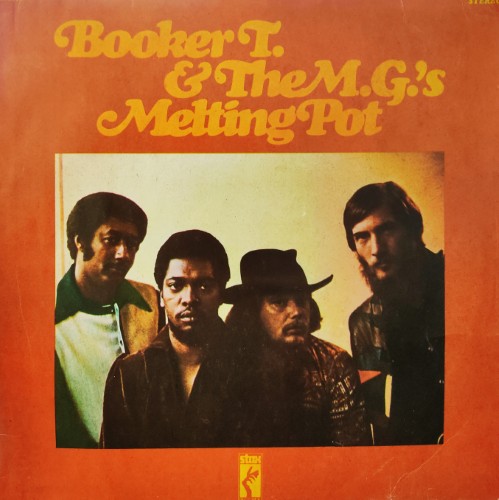
Of course everyone knows the song Green Onions, and I will soon make a point of learning even more about Booker T. and the gang. For today’s cut, however, I’m going with 1971’s Melting Pot, which is probably my favorite track of theirs at this point. Arriving about ten years after their most famous composition, this one is funkier, longer, moves through a number of different passages, though is no less catchy as a result. It’s also from the last album to feature what most would consider their most “classic” lineup.
Their presence here, as a fully fledged, famous, standalone group, has almost turned this into its own roving festival. And if so, is it possible that these four acts make for a more bizarre bill than Lollapalooza ‘93? I am reluctantly forced to conclude it probably doesn’t, especially without even seeing Blind Melon, but the verdict is mighty close.
Starting out as the house band for Stax Records in Memphis, they played on classic numbers by Otis Redding, Wilson Pickett, and the like, beginning in the early 60s. Booker T. Jones (Hammond B-3 organ, mostly) and Steve Cropper (guitar) are founding members, while bassist Donald “Duck” Dunn joined in 1965. Original drummer Al Jackson Jr. was murdered at his own home ten years later, and his seat has since been filled by a rotating cast of musicians — in the movie Blues Brothers, that would be Willie Hall, but on this particular engagement Jim Keltner is doing the honors.
Amid their early run as official backing band with Stax they also recorded their own records, sprinkling in a few hits — Green Onions naturally not just the most prominent, but one of the more instantly recognizable instrumentals ever — and various auxiliary players, like Isaac Hayes in place of Booker T in spots, filled in whenever a core member was busy. One of the first major interracial bands, they are also credited with creating “Southern soul,” for lack of a better term, and later branched out to play in an increasingly rock oriented terrain, with Bob Dylan, John Fogerty, and Levon Helm on their resumes. At Dylan’s 30th anniversary concert in Madison Square Garden they were pegged as house band, and this is apparently where they and Neil first made this fateful connection, which eventually led to this current engagement on the road with him.
For an encore Neil’s backing band is able to indulge in a slice of its own past, as they shuffle their way through (Sitting On) A Dock Of The Bay, which was co-written by Otis Redding and Steve Cropper way back when, in 1967, becoming an eventual hit for them just weeks after Redding lost his life in a plane crash. Then Neil leads the band through a charged rendition of All Along The Watchtower to close out this occasion, as Heather and I, wary of a potential traffic nightmare, book it for the parking lot.
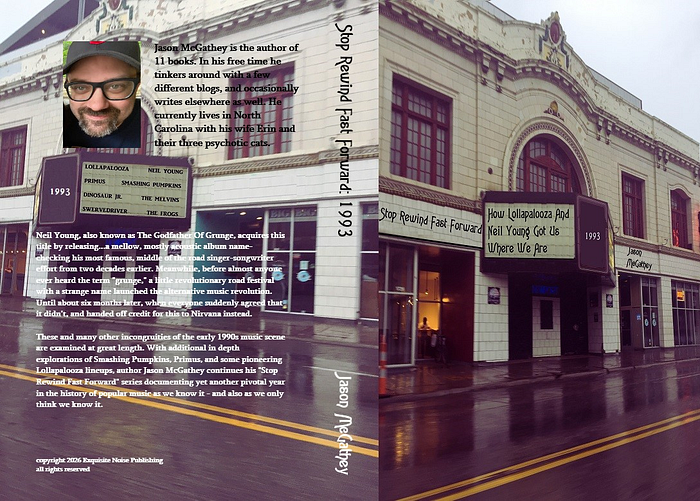
The above excerpt is but a sliver of my extended essay on the Neil Young show, found in my latest music history book, Stop Rewind Fast Forward: 1993. If this grunge-era recap seems like your cup of strong, independently brewed java, you can order it direct from me in a couple different places:
